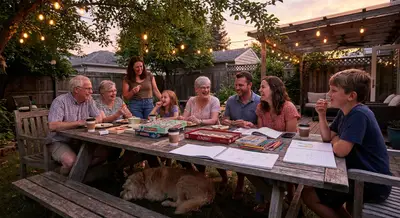
When Everyone Wants Something Different: Finding One Activity the Whole Family Enjoys
Some days it feels like your family is five separate people living parallel lives: one kid wants Minecraft, another wants gymnastics in the hallway, the toddler is climbing the furniture, and you’re just trying to drink coffee before it gets cold… again.
This isn’t a “you” problem. It’s a family-life reality: different ages, different moods, different needs. But there are ways to find activities that don’t require you to become a cruise director or sacrifice your sanity.
Let’s talk about simple, realistic ways to bring everyone together—without forcing “perfect family time” or pretending it’s always magical.
Start Where Your Family Actually Is (Not Where You Wish It Was)
It’s easy to imagine peaceful board-game nights, long nature walks, or elaborate crafts. Then reality walks in with a screaming toddler and a tween who’s “bored already.”
Instead of planning from the fantasy version of your family, plan from the real one:
- Energy check: Is everyone wired, tired, or somewhere in between?
- Wired: movement-based activities (dance party, obstacle course, backyard games).
- Tired: cozy activities (movie “theater,” puzzles, drawing, reading together).
- Time check: Do you have 15 minutes or a full afternoon?
- Short windows call for “mini” activities: one quick round of charades, a snack picnic on the floor, a 10-minute “who can build the tallest tower” challenge.
- Space check: Tiny apartment, shared walls, no backyard?
- Think vertical (tape on the wall for ball toss), under-table forts, yoga or stretching, or sound-friendly activities (storytelling, drawing, simple card games).
A realistic starting point makes it more likely that everyone can actually join in—including you. You’re allowed to choose something that doesn’t drain you further.
Let the Kids Help Design the Fun (So You’re Not the Only Cruise Director)
When kids feel ownership, they’re more likely to participate—especially older kids who might roll their eyes at “family time.” Instead of announcing an activity, build it with them.
Try this simple, low-stress approach:
The Family Fun Jar:
Keep a jar and some scraps of paper. Throughout the week, everyone (including you) writes activity ideas:- “Pancakes for dinner and a movie”
- “Card game tournament”
- “Stuffed animal talent show”
- “Five-minute Lego build challenge”
When you have a family window, pull one out. If it’s totally impossible that day, you get one redraw—no drama.
Rotating “Fun Captain”:
Each week or weekend, a different person is in charge of choosing one family activity. Set simple rules:- It has to include everyone.
- It can’t cost more than X amount.
- It has to fit in your time window.
This takes pressure off you and gives kids a sense of importance and leadership.
Brainstorm once, use often:
Spend 10 minutes one evening making a list together of “go-to” activities. Hang it on the fridge. Next time someone says “we never do anything fun,” you’ve got a ready-made list to point to and pick from.
You’re not failing if your kids say “this is boring” sometimes. That’s just part of being human. Involve them anyway.
Bridging Big Age Gaps Without Losing Your Mind
Having a toddler and an older child (or more) can make shared activities feel impossible. The trick is to aim for layers of engagement: one core activity with different “jobs” or challenges for each age.
Here are some real-life scenarios:
Scenario 1: Building Together
- Core activity: Build a “city” on the floor (using blocks, Legos, paper and markers, cardboard boxes—whatever you have).
- Toddler job: Stack blocks or “drive” cars through the city.
- Elementary-age job: Design and build houses, parks, or shops.
- Older kid job: Make road systems, signs, or create a backstory for the city.
- Your job: Sit on the floor (yes, that counts), ask questions, and maybe build one tiny thing. You don’t have to engineer the whole layout.
Scenario 2: Family Cooking Time
- Core activity: Make one simple thing together—like tacos, breakfast-for-dinner, or DIY sandwiches.
- Toddler job: Wash veggies in a bowl of water, tear lettuce, put napkins on the table.
- Elementary-age job: Stir, sprinkle toppings, read simple parts of the recipe.
- Older kid job: Chop (if safe), cook parts on the stove (with supervision), plate the food.
- Your job: Keep it low-pressure. Mess is expected. This is about togetherness, not a Pinterest photo.
Scenario 3: Story Night
- Core activity: Tell or read a story together.
- Toddler role: Hold the book, point to pictures, choose which book.
- Elementary-age role: Read short parts aloud or act things out.
- Older kid role: Help write a silly group story, do character voices, or draw scenes from the story.
- Your job: Invite, not force. Cozy blankets, dim lights, and snacks help.
When you think in layers, you stop hunting for the one “perfect” activity and instead create small, overlapping ways for everyone to be part of it.
When No One Can Agree: Using Routines and “Trade Time”
Sometimes everyone wants something different and no amount of cleverness fixes it. You’re not alone, and you’re not doing it wrong.
Two tools can help: predictable routines and fair trades.
1. The “Family Time First, Screen Time Later” Rhythm
If screens are part of your life (for most families, they are), you can use them without letting them swallow all your connection time.
For example:
- 20–30 minutes of a shared activity (game, walk, building something).
- Then kids can have individual screen time, if that works in your home.
This helps reduce fights because the order is clear: together first, solo later. You’re not randomly taking screens; you’re following a pattern everyone knows.
2. Trade Time: “Your Choice Now, My Choice Next”
Instead of trying to make every activity everyone’s favorite, use trades:
- “We’ll do your game for 15 minutes, then we’ll do your brother’s choice for 15 minutes.”
- “Tonight is your show, tomorrow we watch your sister’s.”
You can even grab a timer and make it official. The goal is not perfect fairness every second, but a general sense that everyone gets some say.
If a child complains, you can calmly say:
- “I know you don’t love this part, but this is [sibling]’s turn. Your turn is next, and we’ll stick to that.”
Consistency helps kids trust that their turn really will come.
Activities That Feel Like Connection (But Don’t Require a Big Production)
Some of the best “family activities” don’t look like activities at all. They’re tiny things that fit into what you’re already doing. When your energy is low, these absolutely count:
Car Conversations:
On drives, play “Would You Rather,” “Two Truths and a Silly Lie,” or “High-Low” (everyone shares a high point and a low point from the day).Kitchen Hangouts:
While you cook, ask a “question of the day”:- “If our family had a theme song, what would it be?”
- “What animal do you feel like today and why?”
Kids can mix, set the table, or just talk while snacking on chopped veggies.
“Helper Spotlight”:
Ask one child to be your “Special Helper” for 10 minutes.- Younger kid: match socks, hand you items, put toys in a basket.
- Older kid: help plan tomorrow’s dinner, reorganize a shelf, look up a recipe.
Narrate what they’re doing well. It turns chores into connection time.
Mini Walks, Not Big Hikes:
A 10-minute walk around the block, or even in the hallway of your building, can still be family time. Play “I Spy,” count dogs, or look for one specific color.
These small moments matter just as much as the big planned things. Your kids will remember how they felt with you more than what exact activity you did.
When You’re Touched Out or Burned Out (But Still Want to Be Present)
There will be days when you want connection but have absolutely nothing left to give. That doesn’t mean you’ve failed your kids; it means you’re human.
On those days, try:
Side-by-side, low-effort time:
- Everyone brings a quiet activity to the couch or floor: drawing, reading, puzzles, building.
- You sit with your tea or water. You’re there, even if you’re not leading.
“I’ll Watch, You Play” Option:
Tell your kids, “You guys play [blocks, dolls, dance, race cars], and I’m going to sit right here and just watch and cheer you on for 10 minutes.”
Comment every so often: “Wow, that was a big jump,” or “I love how you worked together on that.” It’s connection without performance.Gentle boundaries:
It’s okay to say, “I can play for 10 minutes, then I need a rest.” Set a timer. End when it rings. Follow through kindly but firmly.
Taking care of yourself is not stealing from your family—it’s saving your energy so you can keep showing up over the long haul.
Conclusion
Family activities don’t have to be elaborate, expensive, or perfectly harmonious to “count.” They can be 15 messy minutes of building a crooked Lego tower, walking the same block for the third time this week, or sitting together while everyone does their own little thing.
What matters most is:
- You’re creating chances to see and enjoy each other.
- You’re letting kids help shape what “fun” looks like.
- You’re honoring your own limits so you can keep going.
Your family doesn’t need a picture-perfect memory book. They need a present, imperfect, loving parent—exactly the one they already have.
Sources
- American Academy of Pediatrics – Media and Children Communication Toolkit - Offers guidance on balancing screen time with family interactions and shared activities.
- Harvard Graduate School of Education – Making Caring Common Project - Shares research-backed ideas for building family connection, empathy, and routines in everyday life.
- CDC – Positive Parenting Tips - Provides age-specific suggestions for engaging with children and supporting their development through daily interactions.
- Zero to Three – Play: How it Shapes the Brain, Opens the Imagination and Invigorates the Soul - Explores how play supports children’s learning and offers practical ideas for family-friendly play.
- Child Mind Institute – How to Help Kids Open Up - Gives strategies for everyday conversations that strengthen parent–child relationships, helpful during simple family activities.